Tuesday, June 21, 2016

Reconstructing the family tree of ancient Aegean writing systems

Before going astray and heading straight into Cypro-Minoan matters, I would like to discuss a small but important topic. This post will be about the evolution of the Aegean writing systems: Here, we will attempt to reconstruct their intimate historic connections as accurately as possible based on a rather fragmentary set of evidence available today.

Writing appeared rather suddenly on Crete, at the beginning of the so-called "Middle Minoan period" at the turn of the 2nd millenium BC. It coincided with profound changes in society and culture as well as the accelerated urbanization of the island. These changes are best exemplified by the architectural innovations (such as the ashlar masonry) leading to the construction of the so-called "Old palaces". There can be little doubt that the sudden surge in Minoan technology, arts and culture was triggered by the establishment of regular trade contacts with the advanced Middle Eastern civilizations. With Egypt being the single most influential empire of the region, it is no wonder that the earliest Minoan writing was clearly modelled after the Middle Kingdom Egyptian hieroglyphs.

Although superficially indeed similar to Egyptian symbols, Cretan Hieroglyphs are clearly distinct in both form and phonetic value. Yet the biggest difference lies in the underlying system itself. Egyptian Hieroglyphs are part of a complex writing system, where most signs have more than one possible reading, dependent on context (similarly to the Japanese Kanji characters). Signs could have both a phonetic (single consonant or syllable) value or an ideogrammatic (word) reading, but could even be utilized as phonetic complements or logograms, "reinforcing" the reading of words they were attached to. As many of these duplicities could only be interpreted by a native speaker of Old Egyptian, this system was very difficult to utilize for speakers of foreign languages. Also, the Egyptian system had over 800 different signs, which is an extremely large inventory of symbols compared to Cretan Hieroglyphs (roughly 85 or so different signs are known). Minoan scribes apparently took only the concept of writing from Egypt, creating their own signs and simplifying the system so that it became almost fully phonetic. Such a low number of individual characters is uncharacteristic of the complex writing systems of the ancient Near East, but it is fully compatible with a simple syllabary (reminiscent of the modern Japanese Hiragana or Katakana writing). Thus we can safely assume that Cretan Hieroglyphs, similarly to all later Aegean writing systems, were already syllabic in nature.


Fig. 01: Family tree of Aegean writing systems.


Hieroglyphic Cretan script is mostly preserved on sealstones, but was also used on short clay tablets, bars and labels for the explicit purpose of administration. Other uses were rare; the longest contiguous Hieroglyphic text is found on the altarstone of Malia (in a religious context). As seals might have been used by several generations, it is difficult to judge when the use of the Hieroglyphic script came to an end. One thing is clear: After the rebuilding of the palatial complexes on Crete (with the advent of the so-called "New Palace Period") the Hieroglyphic script fell out of regular use. A new script has taken its place, called Linear A. The relationship of Linear A and Hieroglyphics is probably comparable to the relation between Egyptian Hieroglyphic and Hieratic/Demotic script. All currently available evidence suggests that the underlying system remained essentially the same; it is the shape of signs that suffered profound change due to graphical simplification.

Linear A was used much more extensively than Hieroglyphs. Hundreds of clay tablets, inscribed vessels, statues, altarstones and even jewelery testifies its daily use. The triumph of Linear A is also striking in a geographical sense: Wherever Cretan traders went, Linear A followed. Perhaps due to the simplicity of the syllabary, it quickly spread to other regions surrounding Crete. While regularly used on many Aegean islands, sporadic finds suggest that it also reached the Greek mainland as well as the island of Cyprus and the Syrian coast. In the Aegean region, Linear A eventually evolved into the much better known Linear B. Apart from a few newly introduced signs, the difference between the two linear scripts is merely stylistic; anyone skilled in reading the Linear B inscriptions can still read Linear A with relative ease. Their key difference lies not in the form, but in the language these scripts record: While Linear A inscriptions are evidence of a now-extinct bronze age language of Minoan Crete and the Aegean islands, most Linear B phrases are clearly Greek, an archaic dialect now termed as "Mycenaean Greek". Linear B was used at every important Mycenaean polity on the Greek mainland, yet the largest cache of clay tablets have been uncovered at Knossos, at the final destruction layer of the palatial complex (contrary to Evans, they more likely date to around 1200 BC, contemporary with the Pylos tablets). This is also the latest evidence of the use of Linear B: Knowledge of writing was apparently lost with the collapse of the Mycenaean civilization and the immigration of Doric tribes into southern Greece and the Aegean islands.


Fig. 02: Characteristic signs in Festive Linear A


Some enigmatic findings have also been uncovered on Crete that do not fit into the above, simple model of evolution. This mainly concerns two famous artifacts with inscriptions, the Phaistos disk and the Arkalochori axe. Although their signs are perfectly picture-like, thus reminiscent of Cretan Hieroglyphs, these are NOT written in Hieroglyphic. In fact, they constitute a poorly-recorded variant of Linear A, that I will here term as "Festive Linear A". It is very clear from several signs these inscriptions feature (namely, the "hairy head", the "cat head", the "flying eagle" and the "dotted column" signs) that they cannot be Hieroglyphic. There are no signs that would depict a flying bird in Cretan Hieroglyphic, but there is a clear Linear A sign (with phonetic value KU) with this exact shape. While a cat or a cat head is occasionally seen as a decorative element on sealstones, it is never used as a phonetic sign in any Hieroglyphic inscription; At the same time, the Linear A sign representing the syllable MA very closely resembles a cat's head.

Although it is difficult to read the earliest Cretan inscriptions, it is more-or-less clear that the linear A sign with the phonetic value I evolved from a Hieroglyphic sign depicting a hand with fingers. In Linear A, this sign is not just hand-like, it also resembles a hairy head. On both the Phaistos disc and the Arkalochori axe, the "hairy head" character very likely represents a vowel, and could essentially be identical to the Linear A "I" sign.  Judged by these examples, it seems that Festive Linear A was a throwback to the more picture-like representations seen in Hieroglyphics. Yet by the time these inscriptions were written, Cretan Hieroglyphs were probably already extinct. The mnemonics the scribes used to learn Linear A symbols could have been changed over the centuries, and many of the Linear A characters clearly lost their original shape (see my example of the evolution of the "NA" sign). Therefore their "reversal" to a detailed graphical image sometimes created anachronistic depictions, and these can be quite confusing to even experts of Aegean writing systems. A good example from present time could be the mnemonics used by Japanese students to learn certain characters. The Hiragana sign ね representing the syllable "NE" may be compared to a cat figure (and by pure chance, it does even abbreviate the Japanese word for "cat" [neko]). Yet we know that this sign probably originated from a Chinese predecessor 禰 with honorific meanings "god" or "ancestor" (and obviously not depicting a cat, but rather a sanctuary or shrine).


Fig. 03: Appearance of "NA" sign in different scripts.


While Linear A never managed to gain popularity in any region of the ancient Near East, it has been adopted on Cyprus from early on. Since the languages spoken on Cyprus differed from that of Crete, the script also underwent changes; giving rise to the so-called Cypro-Minoan syllabary (its earliest evidence stems from around 1500 BC.). It might be somewhat surprising that Cypro-Minoan actually consists of less signs than Linear A. Voiced and voiceless stop consonants were no longer distinguished (as a result many D- T- P-series signs and the entire Q-series fell out of use), but an entirely new series of signs was also introduced for syllables beginning with R-. While the main language recorded by Cypro-Minoan inscriptions is still poorly known, a few clay tablets found at Ugarit contain words of undoubtedly Western Semitic origin. This enables us to read a handful of (but not all) Cypro-Minoan signs with some certainty. Unlike Linear B, the latter writing system survived the bronze age collapse, and eventually evolved into the classical Cypriot script. The Cypriot syllabary represents the latest stage in the millenia-long evolution of Aegean writing. Its signs lost all image-like appearance, becoming abstract lines and curves reminiscent of classical Greek letters. Nevertheless, the Cypriot script is still a syllabary, thus very different from the true Greek alphabet (that evolved from the family of Semitic writing systems). Most Cypriot inscriptions are clearly Greek, yet there are still a number of documents that were written in an extinct, local minority language called Eteocypriot. With all likelihood, it is related to the language of Cypro-Minoan inscriptions, becoming extinct only in the classical era. But that is a story for another time...

Monday, March 28, 2016

The great city of Troy - Aegean archaeology and reconstruction of settlements

A warm welcome to everyone! Especially to those who still await new posts. After a long silence - lasting for several years - I finally managed to secure enough free time to continue my research into Minoan matters. This time we shall explore a brand-new question: How accurate are the restorations of Bronze-age cities - if they are based on excavations of their citadels only?

A few years ago as I was travelling through Turkey, we paid a visit to numerous historical sites: from the Neolithic to the Ottoman era. Of these many, one ancient city stands out - because both of its fame and its relatedness to the civilizations across the Aegean. This is the city of Troy, known to Greeks as Ilion. Compared to the impressive hellenistic ruins found elsewhere in Asia Minor, the site of Troy does not offer much to the average tourists. Apart from the few Roman-era remains dotting the hillside, there is very little to be seen. Except for the foundations of earlier cyclopean wallings. However, the building stones seen deep on the bottom of the trench dug by Schliemann betray the lengthy history of this township.


Something that surprises even people educated in ancient history is the high age of this archaeological site. The region of Troy was probably first settled in the Neolitic. Eventually it grew into a village, then a town. As early as in the 3rd millenium BC, it already had a fortified citadel with stone buildings. Schliemann's excavations unearthed some of the wealth that looters did not take. "The golden jewels of Helen" actually belonged to a noblewoman who lived in the age when the Pyramids of Gizah were built! As early as 2600 BC (Troy, layer II), it was already a modest settlement with over 2000 inhabitants, spreading far beyond its citadel on the plains. Troy lay at the crossroads of ancient trade routes - both overland and naval ones. This gave the city a high level of prosperity rarely seen in that period. Remember, that long-range trading already began with the Sumerians. Some of the jewellery found at the excavation of Ur (southern Iraq) had lapis lazuli insets stemming from the mountains of Badakhshan, Afghanistan. The route between these two locations is more than 3000 km (1900 miles) long, and must have taken several months for ancient trade caravans to complete - if there was ever a direct connection. Similar lapis lazuli objects were also discovered at Troy itself, implying a fairly "globalized" trade network of luxuries, even in that early era.

We still have a lot to learn about this period. But it looks certain that Troy (the so-called "maritime Troia" culture) was an exception, rather that the rule. In the earliest Bronze Age, much of the western Aegean was still severely lagging behind the ancient Near East in development. The great "palace" of Knossos was built only a millenium later. The Lion Gate of Mycenae is approximately 1300 years younger, than the walls and gates of Troy II!


 Walking around the archaeological site, there is but one thing disturbing the mind. The excavated area is just too small for such a prosperous town, and we are not even talking about Homer's Troy. It is expected to be a local power, yet there are no more than perhaps half a dozen buildings within the walls of Troy II. Built some 600 years later, the walls of Troy VI form a somewhat bigger circle. Even so, the visible remnants of Troy VI or VII consist of less than a dozen or so buildings. Somewhat unimpressive for those having read Homer's the Iliad (of watched its modern recreation, made in Hollywood).

After the era of high prosperity in the 3rd millenium BC, Troy II was destroyed by fire. But the site continued to be inhabited, even if impoverished. Layers III and IV document several centuries of history, when Troy was apparently disconnected from the major trade routes of the world. Starting from the early 2nd millenium BC (Troy IV and V), the town increasingly fell under the influence of the advanced Anatolian cultures in the east. With the coming of the Late Bronze Age, the walled citadel of Troy was rebuilt again, in a more grandiose way than ever before. Thus Troy VI - roughly contemporary with the palatial complexes of Minoan Crete - was more than a match for the neighbouring Anatolian or Mycenaean city-states. From the Hittite archives, we can deduce that the town was probably called Wilusa, and was possibly a capitol of a local state Taruisa (ancient Greek
Ιλιον [Ilion] and Τρωας [Troas], respectively). Wilusa could have been a member or an ally to the "League of Assuwa", a confederacy of lesser city-states in Western Anatolia (c.f. ancient Greek Ασια [Asia], Linear B A-SWI-JA). Its very existence bothered the Hittite great kings and Mycenaean warlords alike.


 Where could the rest of the city been? Some fairly recent excavations have finally managed to answer this question, by unearthing the outer walls of the settlement, lying far beyond the citadel hill. Troy was a major city of its time and occupied a much larger area than just the hilltop fort. The lower city - the main settlement itself - was several times the size of the archaeological site open to tourists. It has been recently estimated that Troy VI had roughly 10,000 residents. Troy was a great city for its age; even if it was a dwarf compared to the largest Mesopotamian or Egyptian cities, like Babylon during Hammurappi's reign (>60,000 residents) or Avaris, capitol of northern Egypt (up to 100,000 inhabitants).

Clearly, this under-estimation of Bronze-age settlements is not restricted to Troy. The castle of Mycenae encloses no more than a dozen stone-walled buildings; and must have been supported by a major town surrounding its impressive cyclopean walls. Similarly, the Cretan city of Knossos was much more than just the "palace" (the actual city-centre): Some reconstructions depict the excavated buildings lying in a grove of cypress-trees, while this could not be any further from the truth. The outer walls of Knossos (yes, it had walls!) were only found a few decades ago, giving a more realistic impression on how big this city once have been. Knossos was the largest of the excavated Minoan and Mycenaean settlements, with an estimated urban population of 40,000 people.


But if Troy was so large, with well-developed trade relationships and an elaborate culture, why did it lack writing? All the great cities of the era had complex administration systems with written archives: Just think of Mycenae, Knossos, Hattusa or Ugarit.  Together with many others, I firmly believe that the Trojans actually did have scribes and recorded their everyday economy and deeds on clay tablets - like all other civilizations of that time. But for some reason, the archives did not survive after the fire that destoyed the Bronze-age city of Troy VI. The architectural history of the Trojan citadel gives the critical key: the upmost sections of the Troy VI-VII citadel are not preserved at all!

It was not even Schliemann, who removed these sections to expose earlier settlement layers (Troy I-II), but the ancient Greeks themselves. During the hellenistic era, when Troy was rebuilt, the Bronze-age citadel was practically levelled to make place for Greek temples (such as the poorly-preserved Temple of Athena, whose white marble fragments still dot the site). The builders also expanded the hill by systematically dismantling the ruins and using them as landfill, to increase the area of the elevated platform. If the main archives were indeed located in the upmost buildings of the citadel (a likely scenario, in comparison with Pylos and Knossos), then their remnants were irrevocably destroyed in the process. Or perhaps the archaeologists should look for the clay tablets (or rather, their weathered fragments) in the classical-era landfills used to expand the citadel area. Who knows what future excavations might yield there?


With no surviving local archives, one is left to guess what language and writing system the ancient Troyans used. They may not have been restricted to single script, either. A well-preserved Luwian seal, pertaining to a scribe hints at the Anatolian character of Wilusa. But other finds were also uncovered at the earlier excavations. Among them, two vessels bearing crude markings that might (and just might) have been Linear A. These latter finds were even interpreted as a distinct "Trojan script" by some, with Aegean origins. But building a theory on these sparse findings is pointless: We have to wait until more inscribed objects are discovered.

Saturday, March 5, 2016

Minoablog - returning after a long hiatus

A warm welcome to all readers! After several years in absence, I am finally back to continue exploring the fascinating world of bronze-age Aegean inscriptions. It has been a long time and I feel sorry for those who hoped for a sooner return. In the past years, I finished my PhD studies in molecular and structural biochemistry, published two peer-reviewed articles in a row as well as finally completed and defended my thesis. (Although off-topic, those who are interested at the details, you can read our most recent article here. It deals with the language of proteins instead of humans.) Assuming that I shall find time again to do some research into linguistics and epigraphics, I resume blogging on Cretan topics once again.


In the near-future, we will embark on a journey to discover the fascinating world of Cypro-Minoan inscriptions, and the ancient Crete-Cyprus connection. I intend to examine both the doubts and the evidence behind the proposed "Aegean" languge family in a critical manner. In addition, we will tackle the archaeological question of how accurate the reconstruction of Bronze-age cities are. We will also go deeper into the world of Hieroglyphic Minoan inscriptions, and re-assess Linear A grammatic elements with an unbiased method. Stay tuned!

Sunday, September 30, 2012

Correcting some errors of mine...

Hello again, dear readers! While my tedious lab work has left me very little for pastime activities in 2012, I still managed to make some interesting discoveries in the past months. What is more, I even managed to make a minor breakthrough with the Cretan Hieroglyphs. Thus several Middle Minoan inscriptions have now become not just readable, but also meaningful. To achieve this, I had to correct the reading of several signs: even some signs whose case I previously considered "already solved". During my years of research, I observed that most scientists tend to "fall in love" with their own theories: and that is where trouble starts. After all, you should be critical with your own results, even more so than with the results of others. Only so can you ensure the quality of research you provide.

As I mentioned earlier, it is very easy to make unintended errors when attempting to decipher a fully-unknown writing system. And - without enough attention - these early assignment errors will become a true pain in the later stages of decipherment. They would definitely cause the entire attempt to derail at a certain point. My earlier work on the identification of potential 'KA' and 'QE' signs in the Cretan Hieroglyphic system is no exception to the rule. It was too late I realized that the sign I attempted to assign to Linear A 'QE' is in fact non-existent! Although endowed with an identifier by Godart and Younger (as if it were a syllabary sign), Hiero *73 seems to be nothing more than the numeral '100' on the hieroglyphic clay tablets. On the stamps, the few dubious instances of  Hiero *73 are probably identical to sign *47 (the "sieve" sign) or they are just decorative separators. This leaves my earlier theory nothing short of a fancy speculation. But let us start everything from the beginning!

Recently I have put quite some work into adding more signs to the list of "known" Hieroglyphic Minoan characters. With some luck, I was able to identify the probable counterpart of Linear A 'DI' (*07) syllabogram. Now I can state that 'DI' very likely corresponds to the Hiero *11 (the "boucranium") sign. Where do I pull this conclusion from? As we have seen before many times, a mere similarity between the shapes of Hieroglyphic and Linear A signs can be misleading - due to the very significant time gap between the Knossos Hieroglyphic and Haghia Triada Linear A archives. It is as if we attempted to assign our letter 'P' to the classical Greek 'Ρ', not paying attention to the lengthy and non-linear development (Greek letter 'Ρ' is actually rho and corresponds to our letter 'R').


What I apply now is a combined approach based on not just the graphical design of signs, but also on their tendencies to form certain lexeme units. One can note that occurrances of a given open syllable are not random in any language, but they obey certain statistics governing their appearence in a given position relative to other syllables in words. Mathematicians would call my approach "entropy minimalisation". I observed that sign Hiero *11 is very common in not just word-initial positions, but also directly before signs Hiero *56 (= 'NA') and Hiero *29 (possibly 'NI'). All these features are true to the Linear A 'DI' sign as well, probably stemming from the high frequency of the (closed) syllable written as 'DI-N'- in the Minoan language.

The reading of Hiero *11  sign as 'DI' gives words that can directly be paralleled with Linear A forms. As it is trivial for clay bars and medals, most if not all the terms mentioned are names (sometimes with titles). These are mostly hapaxes, even in Linear B. Thus the best one can prove is that the words share their stem, but not their complete form. Such examples include the term A-WA-DI in Hieroglyphics, paralleling the name WA-DI-NI in Linear A (it is unclear whether the latter is a personal or a place-name). It is also notable, that there are plenty of hieroglyphic documents containing the phrase DI-NA. This recalls an interesting word - probably a place-name - in Linear A: DI-NA-U [HT9, HT16, HT25], often abbreviated as just 'DI' on the Haghia Triada tablets [e.g. HT85]. Although the occurrance of the name DI-NA-U on a vessel at Knossos [KN Zb27] suggests potential northern Cretan affinities for this place, so far I was unable to suggest any further identification. One may also read another familiar term in Cretan Hieroglyphics: WI-DI-NI, closely resembling a personal name mentioned on the Haghia Triada tablets: WI-DI-NA [a hapax on HT 28]. Despite all my earlier fancy theries, Hiero *37 could reasonably be identified with Linear A 'WI', yielding the reading above. On one bar, we can find the same signs in a permuted order, giving the reading DI-NI-WI instead of WI-DI-NI. Could this be an early form of Linear A DI-NA-U? There are still so many open questions lingering around hieroglyphic documents!

Still, despite all the above identifications and speculations, an uncomfortable feeling remains. There were no identical phrases in both Hieroglyphics and Linear A, reading with 'DI'. So we still need a better example to ascertain this value. When browsing through the CHIC volume, I came upon a little piece of clay from Knossos (CHIC #45) with an interesting text. There are no logograms on this medallion, as common in Linear A. Nor there are any word-dividers, thus we should read both of its sides as a single phrase. The word definitely spells ?-?-TA-RE (the two last syllabary signs are certain), and now we are in the position to read its initial syllable as 'DI'. But what could the last unidentified syllable be? A value with 'K' would fit very aptly there, with the most appropriate value being 'KA'. This way, the inscription shall read as DI-KA-TA-RE !


Mentions of the sacred mountain Dikte are common in Linear A sources: we have already seen versions like JA-DI-KI-TE-TE- and A-DI-KI-TE-TE- as well as JA-DI-KI-TU on the libation tablets. Linear B sources refer to the place as DI-KA-TA. What we see here is a form similar to the Linear B nominative case, but endowed with a typical Minoan suffix (*-ale) denoting origin, as commonly seen on Linear A tablets (e.g. compare A-MI-DA-U [ZA10] with JA-MI-DA-RE [HT122]). Although the reading is dubious due to the low quality characters, another medallion from Knossos (CHIC #47) may also contain a word DI-DI-KA on one of its sides. If correct, this would exactly be the same as the stem of a Linear A word written on a Zakros vessel (ZA Zb3): DI-DI-KA-SE, dealing with wine, similarly to CHIC #47.

Now we are in the situation, that we need to prove the reading of Hiero *77 as 'KA' in order to validate all these hypotheses. Fortunately, the hieroglyphic archives contain plenty of names: place names and personal names alike. Sometimes these words are written in an alternative form: the same phenomenon has been an important tool for the clarification of phonetic values in Linear B. Although at a limited extent, this approach is also useful for Hieroglyphics. I was able to come across such an intriguing pair of names in Cretan Hieroglyphic. One of the documents, a clay medallion from Knossos contains a separate word (name) on one of its sides that might read as SA?-*77-NI. On the other hand, a seal impression from Mesara (near Phaistos) features a very similar name: SA?-KI-NI.  The only difference is the middle sign: and this is actually explainable if the original name was something like *Sakni. Resolving the *-kn- cluster one way around would give SA-KA-NI (progressive spelling), the other way the result would be SA-KI-NI (regressive spelling).


Time has come to mention another notable inscription. I discovered a spectacular specimen when checking the DBAS database for Hieroglyphic sealstones containing this very character. The seal in question is CHIC #200 (found at Malia) and it is no boasting to call this fine piece of jewellery the "Royal Seal of Malia", you shall immediately see why. The stone seal is unusual in a certain sense that - although it is drilled in the middle and made to be rotated, it has only one flat side that is actually inscribed. Unexpectedly, the "start sign" (that designates the first word to be read) is also in the middle of the line. However, the crowded placement of signs (the two last signs are on top of each other) suggests an alternative arrangement: the inscription might run in a circle!

Using our corrected phonetic values, the first word of this masterwork seal would read WA-NA-KA. This is the same word that Linear B used for the title of a king (wanax in Mycenaean Greek)! Although wanax (stem: wanakt-, behaving as a heteroclite in Classical Greek with a -t- extension) is sometimes believed to be a Pre-Greek loanword, this is the first time we see it in pure Minoan context. Finally, the last sign of the line can be read together with the first one if the inscription is circular; this could be another term specifying the kingdom. This last sign has a somewhat dubious interpretation. Most scholars would read it with the value "JA" without question, but this is not the only possible reading, and might not be the correct one, either. For this instance of Hiero *38 (that could also be Hiero *39) also resembles Linear A "PA3". Plugging that into the Hieroglyphic script yields a very familiar place-name: PA3-NI, mentioned about half a dozen times at Haghia Triada [HT6, HT85, HT93, HT102], and also at other places, like the peak sanctuary at Syme [SY Za4].


Based on the co-occurrances of PA3-NI with other names, it could already be mapped to mid-central Crete (it seldom groups with western Cretan places, and never with more eastern towns like SE-TO-I-JA or KI-TA-NA). Very tentatively, I placed it to Gournia, but Malia would have been an equally good candiate. Now we see the first hint that PA3-NI could have been the ancient name for Malia, and that Malia was a separate kingdom into itself (it had a WA-NA-KA of its own). This is very well in-line with the results of archaeologic research, suggesting that Crete was politically fragmented during the Minoan era into at least four small souvereign city-states or kingdoms, with no central "Minoan" authority whatsoever.

How much do these minor discoveries add to our understanding of Cretan Hieroglyphics? I hope that these bits of information shall be crucial in the future to fully decipher the first known Aegean script. Unfortunately, we still do not have a "critical mass" of known signs. If we had them, they could hopefully start a true chain reaction, suddenly turning all the remaining signs readable  - as happened to Michael Ventris, after he plugged in a critical number of correctly-identified Linear B signs into the grids of Alice Kober. But before we reach that point: well, research must continue!

Monday, April 30, 2012

Exploring the Cretan numeral system

After a lenghty pause, I returned to present some brand-new results of my research. This time, I shall be slightly off-topic, and instead of linguistics, we shall examine the ancient Cretan measurement and numeral systems. Roughly half a year ago, I turned my attention to the still-unresolved questions around the Minoan numeral system. It took quite a lot of comparative research, between Linear A tablets, and even the more extensive Linear B archives, to come to some firm conclusions. Instead of wild guesses like I made before, it is now time to present some coherent theory. I hope you enjoy it!

Like in the lands of Sumer and ancient Egypt, accounting and writing evolved hand-in-hand and thus numeric characters were intergral part of ancient writing systems. Similar in concept to the Egyptian numbers, but not in shape, the Minoan-Mycenaean system was also decimal. The sign of '1' was a simple vertical stroke. Higher numbers consisted of multiple strokes: two for '2', three for '3', etc. In case of discretely countable entities (e.g. people or animals), these signs denote plain numbers, while in the case of goods like grain, figs or oil, the situation is less trivial (more about this later). Different magnitudes have different characters. The sign for '10' is a simple horizontal stroke. Typtically, this precedes the lesser digits, as Minoan and Mycenaean scribes also made some limited use of positional notation. Number '100' is written as an empty circle.  A 'radiant circle' denotes '1000'. There is even a sign for '10,000', a radiant circle filled with a horizontal stroke inside. There are too few examples in Linear A to ascertain the latter values, but since '1' and '10' look exactly the same as in Linear B, it is rather trivial to identify the rest of the integer signs as well. Unlike the rather complex measurement systems of ancient Mesopotamia, Minoans did not have separate counting systems for different goods. The same integer numbers could be applied to items measured by wet volume (e.g. wine, olive-oil), dry volume (grain, figs) or weight (metals). I spent quite some time in the past months, eyeing the Cretan tablets eagerly for any small difference between the ways separate types of goods were catalogued. Yet I failed to find any.


To understand how Cretans were able to use essentially the same measure system for fluids and solids we should examine how later Hellenes did define their measurement units. It seems that everything revolved around a base unit, the quantity of water a single amphore could hold. The volume of an "average" Greek amphore differed from place-to-place, but was roughly about 19 to 36 litres. This is suspiciously close to the Minoan volume unit restored based on a vessel from Zakros (ZA Zb 3). An inscription mentioning 32 units runs below its rim; the actual volume of the pithos is slightly above 1000 litres. If it was meant to be full, the Minoan volume unit is around 32 litres; if not, it is somewhat smaller (29-31 L). Equally, this integer unit could also denote a weight of 29-32 kilograms, since the density of water (or wine) is 1.0 g/cm3. Ancient Greeks also defined their mass units based on this hypothetical standard amphore: the weight of its water content equalled one talent. The talent was further sub-divided into 60 minas, following the ancient Mesopotamian tradition of 60-based systems. For a Minoan scribe, it must have been trivial to switch between specimen numbers, volumes and weights using this simple and easy-to-learn system of counting by amphores.

While the system of integers is simple, nice and succint, the fractional units are unexpectedly complex. Both the earlier Minoans and later Mycenaeans used a high number of fractional signs to express quantities less than their (rather large) base units. Yet here the two systems are rather divergent: Mycenaean fractional units are usually specialized to measure different goods by either volume or weight, while this is not the case for Minoan fractions. But the two systems are not as radically different as one might think - we shall see this soon enough. Since ancient peoples had no knowledge of irrational numbers, all non-integer quantities typically denote simple, rational fractions (e.g. 1/2, 3/4, 2/5, etc.). Any quantity that was smaller than the unit, was to be approximated by a sum of these fractions. Egyptians preferred the use of fractions of the form 1/n (n = any natural number). One does not need to be a mathematician to prove that if we defined 1/n-type signs for all n<N, using a sufficiently high N, all quantities can be approximated arbitrarily well with this system. So we only need a finite number of fractional signs, if it is our objective to measure with a fixed error margin.

The most common fraction seen in Linear A is named 'J', graphically looking like a "lesser than" sign. This is - obviously - the one for 1/2. There are plenty of tablets with totals (e.g. HT9, HT104, etc.) to demonstrate that. The second most common fraction is labelled 'E', it looks like an almost exact mirror of 'J'. This has (you could have guessed it) the value 1/4. The next symbol in this series is a bit more tricky. Sign 'F' looks like 'E' with a horizontal line crossing it in the middle, thus symbolically cutting it in half. To show that this one is 1/8, we also have direct proof: on tablet HT8, there are two fraction 'F's following two well-established names (QA-*310-I and PA-JA-RE) thus they need to add up to 'E' in order to make that calculation work.


With a little luck, we can even identify the sign 'H' as 1/6. Tablet HT123+124 features *122 and *308 quantities for each name, being nicely proportional (3:1) to each other for practically all lines. You can see this on my reconstruction above. Based upon the considerably high quantities, *122 (= RA3, "LAI")  is probably OLIV (olives), and not CROC (saffron), the only other Linear B logogram similar to it; but there is no hint on the identity of *308. Due to the fragmentary nature of this tablet, it is not the easiest thing to reconstruct the exact numbers that once stood in each entry; yet the end totals give enough constraints (in the form of an equation system) to fix most illegible fields. To make this work, one has to propose, however, that the scribe sometimes disregarded the positional notations when making calculations (there is ample evidence that the same happened on side B of the very same document). If we also assume that the scribe made no errors upon totalling, there is only one correct solution, that you can see on my facsimile.  Interestingly enough, the tablet - if read properly - yields evidence on the existence of a sign with 1/12 value. As the sign 'X' (Godart & Olivier) on the end of the second line is more plausibly read 1+'A', this strongly suggests that sign 'A' had the value 1/12.

Finding out the exact value of other fractions is more tricky. For example, there are the 'B' and 'D' series of fractions - both reasonably common. Obviously, one would expect fractions with a higher value (lower denominator) to be more prominetly featured than quantities below 1/10. This would mean that the fractions 1/3 and 1/5 be the most common. As there are not many ancient numeral systems putting a stress on 1/7 and 1/9 fractions, these ones were probably rare in Mycenaean and Minoan contexts - if existent at all. This leaves us on a quest to find out how to match the 'D' and 'B' series to derivatives of 1/3 and 1/5.

We have very little information on the true value of the 'D' sign (looks like the Latin letter 'S') and the related doubling 'DD'. John Younger tried to pursue the idea that these are exclusively dry weight measures - based on their close similarity to the Mycenaean  'M' sign used for metals or wool; but none of the tablets support Younger's conclusions. 'D' and 'DD' are seen with every imaginable type of goods, even with olive-oil. This indicates that it was a generic fraction, not exclusive to - say - cereals. Others (Dieter Rumple) suggested the value 1/5 - again, without any convincing proof. That idea solely relies on a single tablet (HT115), where a quadrupling of the base fraction unit (DDDD) can be read. As for me, after a thorough research, I came to the conclusion that the value of 'D' is probably 1/3. 'DD' would therefore be 2/3. As for 'DDDD' (4/3), one must see that similar overshoots are rare, but definitely do exist on several tablets (JJ=2/2 [PH9, PH22], EE=2/4 [PH12, PH13]). Now, if 'D' is indeed simply 1/3, it can also nicely explain the graphical image of fraction 'H' = 1/6. Numeral 'H' looks as if it were carrying the upper half of 'D', divided by a line below. Similar to the way 'F' = 1/8 was built, its graphical image actually shows (1/3) / 2 = 1/6 ! Linear B documents have a similar sign to represent a  (wet volume) unit ('S'), that might indicate a quantity 1/6 instead of the previously proposed 1/3 (by Chadwick). It probably evolved from a mirrored version of Linear A  fraction 'H'; similarly to the way the Mycenaean fraction 'V' seems to correspond to the Minoan 'L' family of fractions.


The 'B'-series of fractional numerals is definitely more complicated than the 'D'-series. 'B' looks like a plain cross. 'BB' is a simple doubling of 'B', but there are also a couple of signs ('K', 'A', 'X', 'W') that resemble the shape of 'B'. How many of these are related to the base sign 'B' is still an open question. Fortunately, this time we do have some solid evidence on our hands for the value of  'B', albeit meager in quantity. Tablet KH7 appear to contain food rations shared among a fixed number of people. The rather strict proportinality straightforwardly implies that 'B' is in fact 1/5. While different tablets seem to employ slightly different food shares per person, we can probably accept that on the same table, rations are more likely to be fixed. Interestingly enough, two closely related Haghia Triada tablets (HT16 and HT20) - both mentioning a list of animal products - appear to list goods proportionally to one another (WA:*188+KU = 1:2), if but only if 'B' = 0.19 ~ 0.2 = 1/5! 'B' definitely follows both 'J' [KH5, KH6, KH17] and 'E' [KH9] on the tablets, thus (from the positional notation) suggesting that it is indeed < 1/4.

Sign 'K' is one probably related to 'B'. Its appearance is indistinguishable from the Linear B fraction 'T', of a value 1/10. Graphically, it is just the lower half of sign 'B' (1/5). Earlier, this sign was assumed to have a value as small as 1/16, based on a flawed piece of 'evidence': the graffito on the wall of a house at the Haghia Triada site (HT Zd 155). It was interpreted by some authors (Pope, Olivier, Stieglitz) as a geometric series. I examined that piece eagerly, but much to my dismay, it is just another piece of 'wishful thinking'. The "inscription" is nothing but a maze of purely vertical and horizontal lines. There is probably no fraction 'K' there at all, and the two last signs (that were even transliterated by J. Younger as TA-JA) are nothing but speculations (note that these signs consist exclusively of vertical and horizontal lines). So I must reject any identification of fraction 'K' as the half of sign 'F', and rather insist on inferring its value from the Mycenaean counterpart (very likely 1/10).

Quantities 'A', 'X', and 'W' are pretty mysterious. All these appear to be rather small. (Note that the reading 'ABB' on KH 86 is apperently faulty, the entire number is likely just a single 'X'.) Although I previously pursued the idea that sign 'A' might be related to the 'B' series (1/5 based), now I uncovered pieces of evidence (see the restoration of tablet HT123-124) that it could plausibly be just 1/12. While fraction 'A' has no Mycenaean counterpart, fraction 'X' corresponds to a Linear B weight unit 'N', used for metals or wool. Since it would not make much sense to propose sign 'X' to be another 1/6 quantity, this leaves it unidentified for now. No matter how well this would fit the proportion M:N = (2/3) / (1/6) = 4, as in Linear B. Fraction 'W' is only seen on a small number of Khania tablets (KH12, KH60, KH61, KH77), offering no clue for its value.


The smallest units ever used on Linear A are - no doubt - the so-called 'L'-series of signs. This is the only instance where signs are supplemented with counting-strokes on their right side in Linear A (this was customary in Linear B for all fractions, though). The very base unit (that has no counting stroke) is called 'L', but it was seldom employed. It is much more commonly used with 2 strokes (L2), 4 strokes (L4) or even 6 strokes (L6). L5 is never found, and L3 is rare as well (the only unambiguous example stems from a single Middle Minoan Knossos tablet). Again, we have no direct proof for their values. This opens up the place for wild speculations. Formally, the fact that L3 and L5 are disfavoured, would suggest that the denominator of L-fractions (if common) was divisible by both 3 and 5. The smallest such number is 15. The problem here is that L2 very commonly follows fraction 'K' on the Khania tablets, that would make little sense in terms of magnitudes (as 2/15 > 1/10, obviously). On the other hand, the L-series of fractions are apparently related to the Linear B quantity 'V', sometimes termed 'choinix', based on the similarity of 'Z' and 'V' fractions to the classical Greek κοτύλη and χοῖνιξ volume units. The problem there is that their proportion to the base unit ('1') is not fixed, but different for fluids and solids, giving no candidate number for the denominator of  Linear A fraction 'L'. (You can see a sketch of the Mycenaean systems above.) John Younger attempted to use Khania tablet KH7 (that you could also see a few paragraphs before), to fix the value of L2 at 3/20. But this complex value would make little sense. Also, the numbers in the penultimate entry reconstructed by Godart are probably slightly faulty (it likely mentions 37 people, not 38). Yet the next line may feature the text KI-RO (badly damaged). If so, then L2 and L6 must ad up to 1/10. If they have the same base denominator (that is probable), then L = 1/80. This would also offer an alternative explanation why examples with an odd number of strokes were rare: because it was used primarily to express 1/40 units (L2 = 1/40, L4 = 2/40, L6 = 3/40, according to this theory). Note that L2 is reasonably common with grain portions (especially at Khania). In Linear B, the daily meal of an average worker was three 'kotylai' (Z3), that might be corresponding to exactly unit 'L' in the Minoan system.

Other fractions still exist in Linear A contexts: they are still unresolved, and will probably remain so. Such ones are fraction 'Y' (seen only at Phaistos [PH26]) and fraction 'Ω' (seen as a vessel-qualifier at Malia [MA10]). There might have been graphically distinct fractional signs for all numbers of a form 1/n for  sufficiently high integers - say n < 20, but numbers that were rarely used (as they were of a prime n or they did not match the procession of any quantity) were unlikely to appear in regular accounting. While fraction Y might have been something like 1/7, with the lack of evidence, it will essentially remain undeciphered in the end.

Thus we have seen that - while there are still many unsolved problems in ancient Aegean metrology, some questions may be answered with pure logic and deduction. This also applies to the Mycenaean units. Encouraged by the Minoan discoveries, I made slight changes to the metric procession of Linear B dry and wet units. You can see this on the table above. With the different densities of water and (ground) grain taken into consideration, this system now perfectly meets all expectations of precise metrics. The only thing that needed changing was unit 'S' (now proposed to be 1/6 instead of 1/3). While Kim Raymoure's Linear B database offered no example of S3, S4 or S5, this only means that 'S' ≤ 1/3. And this is what we have to contend for the time being. Unless we are willing to bravely attempt to fill in the gaps in our current knowledge.

Tuesday, January 3, 2012

Riddles in Linear A - Part II

Happy New Year to everyone! I hope you enjoyed my last post about hard-to decipher Linear A tablets. Now we shall examine some even more mysterious ancient documents: those ones that can only be understood if we analyse not just the names - but the numbers standing beside them. It is now time for some mathematics!

The most obvious problem one can encounter when reading Minoan clay tablets is the lack of knowledge about the transaction terms themselves. After all, how can we understand anything about Cretan accounting, if we do not even know if the goods mentioned were actually collected or - on the contrary - distributed? Our path is clear: to understand more of the meaning of the tablets, we have to analyse the quantities of wares.


Let our first specimen to study be the clay tablet HT8 (see figure). This tablet is fortunately complete, and written with easily readable characters. But it still somehow lacks in clarity. Judged from the absence of any totalling term (KU-RO), it likely lists outgoing goods: the headers seem to list the total stockpile of oil (OLE+KI) to be distributed. The modifier 'KI' might point to a type of "scented oil" (e.g. rose-scented or sage-scented) that was sent to sanctuaries of gods all across the land on certain annual festivals - if we can believe the Linear B tablets already deciphered by Ventris and Chadwick. The distribution patterns on HT8 are quite intriguing on their own, and may admit more than one possible solution. At least some of the entries must be transaction terms, otherwise the numbers would not work. The most trivial solution to the problem was found by Brent Davis & John Younger. But this is not the only possible one. You shall also see my rival hypothesis on the same figure.

The main strength of the original solution is the ability to interpret both sides of the tablet as complete and integrated entity. However, Davis & Younger needed to assume two transaction terms to achieve this goal - both the sole 'PA' syllabogram and the hapax word SU-PU2-*188. Although a single 'PA' returns on other documents, no other tablet supports their reading as transaction terms. On the other hand, most names clearly recur on other tablets, such as PA-JA-RE [HT29, HT88, ZA10], TE-WE [HT98] or QA-*310-I [HT85, HT122]. HT85 even features a similar single-syllable 'PA' term. However, on the toponym list HT85, 'PA' probably abbreviates PA-I-TO, the name of Phaistos. It is tempting to believe that the same applies to the place-name list on HT10, where a toponym tied to KU-NI-SU (Knossos?) is contrasted to a list headed by 'PA' (tributaries to Phaistos?). To remedy the situation, I played around the numbers to find an even better solution to this tablet. As you can see on the figure, if we split the document into two almost-separate lists (with 15 units of oil to distribute, instead of 10), we only have to assume the existence of a single transaction term on side B. KA-PA is a more-or less obvious candidate: it also returns on the headers of tablets HT6, HT94, HT102 and HT105. On HT11 and HT140 we also find a counting term 'KA' (abbreviation, KA-PA?) that frequently stands beside large quantities without any names mentioned. KA-PA is likely related to another word: KA-PE [HT9], that is undoubtedly a transaction term, and stands as contrasted to SA-RO2 on the same tablet. Note that KA-PA itself can form a single expression with SA-RA2 (as on HT102), but it never-ever joins up with A-DU (another common term alongside SA-RA2).

To understand the complementarity and mutual exclusivity of these transaction terms, we must make some assumptions on their meanings first. SA-RA2, one of the most common transaction terms on the Haghia Triada tablets could be cautiously translated as "supplies" (note that it almost always stands before a list of consumables, most typically GRA [wheat]). I chose the word "supplies" to avoid any explicit implications to incoming or outgoing transactions - that are often difficult or impossible to guess. As for A-DU, after a thorough study, I find the reading of John Younger (A-DU = "assessed") really enticing. Now, if KA-PA would mean something like "leftover", "remaining", we could now explain entire phrases: A-DU • SA-RA2 [HT99] = "assessed supplies", TE • A-DU [HT92, HT133] = "give (as) expected" KA-PA • SA-RA2 [HT102] = "remaining supplies", SA-RO2 = "supplied", in contrast to KA-PE = "of what remains". KA-PA can be used with a wide variety of goods, even people [HT94, HT105], in which case, they are counted by type (profession) and not by provenience. On HT102, KA-PA stands before a very substantial number of GRA: 976 units - that would be about 32,000 litres of wheat if measured by volume - likely the whole stockpile of an entire settlement. There is even a Classic Greek word: κάπηλος of prehellenic origins, meaning "local wholesale merchant" (i.e. who dealt in the surplus goods a community produced), that could possibly be connected with KA-PA / KA-PE.

It is also important to examine the dual 'PA3' syllables that start each sub-list. Since the tablet completely lacks word-dividers, these particles might form separate words. Unlike 'PA', the abbreviation 'PA3' (whose reading as a member of the P-series is only weakly supported in Linear B) is a well-attested transaction term (HT9, HT34, HT103, HT132). Its occurrance on HT103 in particular, suggests a reading like 'delivery'.

Tablet HT8 is also interesting because of a completely different reason: it features the rare sign Lin A *188 twice. While *188 also stands as a separate word (abbreviation of a name?) on several documents (HT15, HT56, HT103, HT123, HTWc3014, HTWb229), not just on HT8, here it also recurs as part of a longer word: SU-PU2-*188. This is particularly intruguing because of the phonological character of 'PU2'. That is quite a special syllabogram, as its use in words DA-PU2-RI-TO-JO (Lin B *daburinthoyo) and DU-PU2-RE (Lin A *duphre?) shows: unlike the ordinary 'PU', its consonant might have been at least partially voiced, possibly due to external triggers [clustering with thrills or nasals]. This realization may imply sign *188 being of the the N-series. Interestingly, the N-series has a very obvious hole in it in Linear A: the ancestor and Minoan counterpart of Linear B *42 ('NO') has not yet been identified. Now we have a plausible candidate - but this topic clearly deserves its own post, so I shall leave it to later. Nevertheless, a reading SU-PU2-NO (*suphnú) speaks for itself, and even resembles to the modern name of the island Siphnos - known to be an important economic center (thanks to its precious metal mines) of the Cyclades in the Bronze Age and later. Though it is also true that the naval distance between southern Crete and Siphnos is substantial, so a direct identification is questionable at best.


Now, let us turn to our attention to another piece of numeric riddles. Tablet HT103 offers an equally difficult puzzle as our previous one was. Although HT103 is slightly damaged at its right edge (rendering some signs only partially legible), it is preserved well enough to enable a clear reading without major reconstructions. The first sign on the header is abraded, but - if we can believe the reconstruction of J. Younger (that I also find plausible) - the first word was probably U-TA2. Note that a tablet written by the same scribal hand (HT26) features a very similarly shaped 'U' sign that we reconstructed here. U-TA2 would be a hapax term, albeit it resembles to both an alternative reading of KN10 (inital word: TA-NU-TA2-TI) and to the supposed Eteocretan term 'utat'. Potential tyrrhenian parallels (Etruscan *ut-/*uth- = "to deliver") would indicate a transaction term, having to do something with distribution of goods. Indeed, the header continues with the logogram 'NI' (figs) and a number of 40. Since there is no totalling term anywhere below (although we have KI-RA for missing units), and all the numerals on the tablet are considerably smaller than 40, it appears to be recording the act of distribution.

The key to understanding is provided by the obervation that practically all quantities recorded are multiples of 6.5: Number 13 (third line) is the double of this base portion, and the single unit mentioned in the last line also gives 1+5.5 = 6.5, if we add the missing 5.5. The tablet apparently records an attempt to distribute the initial 40 units of figs into 6 smaller, equal units. This gave a standard unit (with the qualifier DA-KU-SE-NE) of 6.5, and the double unit (qualifier: *188) of 13. Since 40 = 6 x 6.5 + 1, the remaining 1 unit of fruits is distributed as a portion , with the premise that 5.5 would be paid later. The initial segment of line two has broken off, but - judged from the inclination of signs - a syllabogram must have been there before the number, probably 'TI' (c.f. DA-KU-SE-NE-TI [HT104]). DA-KU-NA appears to be just another grammatic case of DA-KU-SE-NE, with a defective writing (*DA-KU-SA-NA) - this points to DA-KU-SE-NE being something like *takusne.

Now we have seen that - with ample effort - many of the tablets can be given a fairly meaningful reading. Unfortunately, I lack the time and resources to continue on this path and examine each tablet separately, but I promise to come up with other Cretan topics soon. Including the revision of some of my earlier theories.

Saturday, November 12, 2011

Riddles in Linear A - Part I

I am pleased to announce that I managed to make a further post on this little blog. In the recent months, I browsed through quite a few original Linear A tablets (I mean, the "original" photographs), in an attempt to make the classification of certain signs more systhematic. Given the paucity of my free time, that project is still ongoing. But in the meanwhile, I also came upon many documents, whose reading and interpretation is quite tricky: Sometimes even well-established scholars were fooled by these muddled tablets. So I decided to share some of these minute discoveries with you, while I keep on analysing the other tablets to get (hopefully) some major results.

Basically, there can be several problems with the reading of a Linear A document (I assumed that you are familiar enough with the Aegean syllabaries in order to be able to read it): First, the tablet can be physically damaged, or be rendered illegible by improper scribal work (erasures, corrections). But even if it is otherwise well readable, the compressed context (and hard-to-interpret words) can make reading a real nightmare. I decided to break this lengthy topic into two parts: so I shall leave the "logical games" for the next time.

To begin, let us take a look at the tablet HT6. This is a tablet with quite a mixed context: Side A lists a variety of commodities (probably foodstuffs: figs and other edible materials) linked to a few names, while the tablet clearly switches to a simple list (of one commodity) on side B. To be more precise, this change in context already starts on the first side, following the entry referring to goods associated to the name DA-QE-RA. All the further entries on side B thus must refer to either PI-TA (bread?) or NI (figs), due to the "continuity principle" (as established by J. Younger). Though we cannot determine the exact goods, it is certain that all the names mentioned are somehow connected to food supplies. A few entries are definitely references to towns. Unfortunately, it cannot be decided whether some of the names are personal ones or all refer to places; though they could also plausibly be a mixture of these two. Nevertheless, tablet HT6 shall be a good example to illustrate how damage (wear, abrasion, breaks and missing pieces) cause problems in reading.


On side B, the first two names are easy to make out, but problems start to mount from the third one onwards. This term (name) spells at first sight as MA-RI-?-I (reading suggested by Olivier, Godart & Younger). It is pretty hard to identify the third sign of this sequence. It looks faintly like a malformed 'I', although the Lin A *28 signs never have a downward-directed right stroke like this. Olivier and Godart tried to suggest 'RE' (this is also how they presented it on the GORILA's official facsimile), but the sad truth is, it is nowhere near *27 (RE) in shape. Because of these difficulties, John Younger did not even try to read this sign. I also suggest the dear reader to ponder a bit on the problem before looking at the solution.

The answer to this question is provided by a simple observation. The table is badly abraded at both of its right and left side on many spots. That's why the baseline of the 'RI' sign is missing. But the same abrasion also covers the lower left end of our mysterious sign. Only a very faint crack is left. Once we draw that small trace with full width, we get the answer. The "mystery sign" is nothing but an ordinary 'KE', a bit damaged, but still legible. One should also note that the 'I' sign is in fact not a plain Lin A *28, but - observing the strokes above its right extension - it is the sign what Godart and Olivier labelled as *28b. Based on its distinct usage pattern, and its undeniable similarity to Linear B *43 (I3 or AI), I would propose to read it as 'JI'. The difference between this and the ordinary 'I' might be negligible, but 'JI' would fit the junctional rules (E-I → E-J) a slightly bit better. These observations yield the reading MA-RI-KE-JI for this name: simply and clearly. Logically, it should be a name, possibly a personal name, being a hapax (though I am not immediately swayed by random parallels like Semitic *mlk = 'king').

But the true riddles just start here! Immedietaly after MA-RI-KE-JI, the text seem to end abruptly. However, the traces of a '1/2' numerical sign following the three clearly visible strokes warns us that the text is probably abraded, but the row is not empty. The faint traces on this part probably belong to two additional syllabary characters, that start the word readable in the next line. The abraded pieces of lines are themselves perfectly compatible with the reading KU-DO-NI. The rest of the phrase reads DA-MA. This is not a compound word: the word-separator dot is small, but clearly visible after KU-DO-NI (placed to the base of the sign, as on side A). While KU-DO-NI is clearly a place-name (= Lin B KU-DO-NI-JA, modern Khania), the meaning of DA-MA is less clear: nevertheless, it does resemble the stem of Linear A words DA-ME [HT86, HT95, HT120] and DA-MA-TE [libation vessel KY Za2]. The following word is equally tricky to read: it consists of merely two signs (the traces before it belong to an 'L2' fraction sign (number), possibly 2/15), but the first one is damaged. Following the traces on the abraded surface, a 'TE' sign would be the most reasonable reconstruction. This yields a name TE-KI, which is - again - a toponym (perhaps denoting the ancient Greek town of Tegea on western Crete, near Khania). The text continues with further putative tomponyms, such as SA-MA [HT10, HT52] and PA3-NI-NA (as on HT93, an adjectival form of PA3-NI [HT85, HT102]). The last two lines also show traces of erasures: the 'MA' sign of SA-MA was erased, and then re-written, similarly, before the PA3 of PA3-NI-NA, there are traces of an erased sign, probably KU, but it was later completely overwritten with numbers belonging to SA-MA.


Tablet HT85
  Statement     Quantity  
A-DU • *307+*307 (women?) •
VIR (people) • DA-RI-DA
 
12
PA3-NI12
U-DWE-ZA6
DA-SI-ZI24
KU-DO-NI5
TE-KE3
DA-RE4
KU-RO66

KI (=KI-RO?) • KI-RA-JA •
KI-RE-TA2
 
1
QE-KA1
PA (=PA-I-TO?)1
TE-TU1
KA (=KA-NU-TI?)1
DI (=DI-NA-U?)1
ME-ZA1
RE-DI-SE1
WA-DU-NI-MI1
MA-DI1
QA-*310-I1


To verify our corrected list, we should turn to other - much better preserved - toponym lists. The best counterpart could be HT85 (see the table above). Not only many of the terms seen on the second part of HT6 recur here, but their relative order and grouping is also similar. Here, KU-DO-NI is directly followed by TE-KE (=TE-KI), just like on HT6. These two terms also directly stand next to each other on HT13 - the tight association of the two places could be very elegantly explained by the geographic proximity of Khania (Kydonia) and Kissamos (Tegea). But this is not the only pair repeated here. Though a much more obscure term, WA-DU-NI-MI is also paired with RE-DI-SE (=RA-TI-SE?). While I have no idea of the identity of the former, the latter name could easily be a declined form of RA-DU [HT58, probably also on the toponym list HT122], the name for ancient Lato (Lin. B RA-TO), near modern Aghios Nikolaos. RA-TI-SE and RE-DI-SE could both be slightly erroneously written versions of *RA-DI-SE then (c.f. QA-RA2-WA [HT86] which is undoubtedly equal to QE-RA2-U [HT95] as the rest of the two lists are the same). Note that HT 85 also contains plenty of abbreviations. While the sole KI sign on the header of side B is probably an abbrevation for KI-RO (=missing), other single syllables likely stand for well-known places: PA = PA-I-TO (Phaistos), KA = KA-NU-TI (?) and DI = DI-NA-U (?). All these three re-occur on HT97, where two of the three are written out in full (save DI, which is probably DI-NA-U [as on the toponym list HT9]). This slacky habit of Minoan scribes to abbreviate commonly used names is unique to Linear A; Mycenaean Greek scribes using Linear B had more strict rules and names were never abbreviated to a single syllable.

Lists counting persons are just as common in Linear A as in B, but they attempt to be as compact as possible. The scribes were often so absorbed in this goal, that they also sacrificed clarity for shortness, leaving behind considerable ambiguity. In some cases, the context can still help to solve these issues: for example, what could a sign 'NI'(*30) mean? First, and foremost, it can designate a type of goods, namely 'figs'; but it can also abbreviate transaction terms and even names. Because of the context, we can almost be certain that it meant the fruits on tablets like HT6, but it is an abbreviated transaction term on HT88 and HT99 (in contrary to the opinion of J. Younger, these tablets almost certainly count people as shown by the consistently integer values and have nothing to do with figs).

But it is not just the wear of centuries that can cause troubles at reading. The slack of certain scribes is definitely a contributory factor. The tablet HT29 shall be a good example of this. This small clay piece if full of erasures, hastily-written, malformed signs in irregular lines. As the scribe tried to salvage a tablet by erasing its previous contents, he sometimes unconsciously re-used earlier, half-visible strokes. The result is a complex maze of lines, parts of half-erased and rewritten signs. There is no surprise why all scholars had problems when attempting to read this document. But we shall see soon, that some names written on this tablet are fortunately not unique and thereby reconstructible by comparing the sign-groups with those on other, better-looking documents.


When attempting a reading, we already run into difficulties right at the first line. Although the term RU-MA-TA can be read with some effort (this name is also seen on HT99), the upper right corner of the tablet is broken off, preventing us to identify any logogram describing the goods assessed. But the strictly integer numbers themselves already suggest that it may count people; the suspect is just reinforced when finding traces of an earlier, erased VIR sign just at the initial position. So we may relatively safely assume that the numbers refer to people (just as Schoep has suggested) - and as we shall see soon - many of the names (entries) are probably places.

While the fourth term on this list can be easily identified as PA-JA-RE (also found on HT8 and HT88) despite its last sign being missing, the second and third names are a real headache. As they are apparently hapaxes and both miss some signs (on the broken-off segment), they cannot be restored with any level of certainty. And we are also plagued by the fact that some of the visible signs are in fact re-used fragments of erased ones, frequently making them nearly unidentifiable. One of the possible readings of the second line is ?-DA?-QI?, with the 'DA' sign seemingly being a salvaged upper part of an erased *310 one. The last sign here is so malfomed we cannot be certain of its reading, either. I only put 'A' as the hypothetic missing initial syllable, because a word exists on the Khania tablets (KH92: A-DA-QI-RI) that faintly resembles this garbled one.

The third name is much better legible, but it still has at least one initial syllable missing (as judged from the size of the broken fragment). Fortunately, the erasures that make our life hard, now also offer some help. In most cases of tablets with visible erasures (as on HT86), the erased text contains the same or almost the same entries as the latter one. HT29 is no different in this regard. Actually, behind the syllabograms 'DI', 'JA' and 'I', we can regognize earlier traces of the same, hinting that this name was erased, but then the scribe re-wrote it to almost exactly the same spot. Careful examination also reveals that an additional sign was originally also written in this line, right before the other three: judged by its shape, it was possibly JE, so we may use this information to reconstruct this term as JE?-DI-JA-I (still a hapax, and hard to interpret).

From the fouth line, we have an easier job. Not that the signs were written with more clarity: The fourth word reads as either SA-?-RE or SA-?-SI at the first sight. The middle sign was interpreted as a somewhat misshapen *323 logogram by Godart and Olivier. But at a closer look, it rather resembles a hastily-written 'MA' sign (the 'cat head'), to which the sloppy scribe simply forgot to add the ears and eyes. This means that the word recorded here was probably SA-MA-RE, a declined version of the putative place-name SA-MA [HT10, HT52, also SA-MA-TI on HT39]. Again, the erasures reinforce our reading: traces of earlier, erased 'MA' and 'RE' signs are discernible somewhat right from the actual term (this also helps to make clear that the last sign was indeed 'RE', and not 'SI'.)

Immediately thereafter we can see another suspicious term. This was read as ?-KI-TA by J. Younger. Godart and Olivier even labelled the misshapen initial syllabogram with a novel identifier as *340. But this one really looks like the upper half of a well-known *306 sign - of which the lower half was accidentally erased by the scribe, when plowing over the next line to be obliterated. If so, the reading was originally intended to be *306-KI-TA or WO-KI-TA - perhaps unsurprisingly - another place-name. This time again, the traces of all 'WO', 'KI' and 'TA' are also visble under the erasure, shifted rightwards with two positions (partly under the next word).

The last two words appear to be hapaxes, and - as a consequence - difficult to ascertain. The logic of erasures - both A-RE-DA?-I and QA?-DU-MA-NE were re-written while shifting leftwards - still helps a bit. Since there is a nicely visible erased 'RE', and there was clearly an 'I' sign behind the 'DU', it is probable that the sign at the beginning of line 5 is a superimposed image of an earlier 'DA' (that the scribe failed to erase) and another one with a rounded top, possibly 'QA'. Note that originally there was another term after WO-KI-TA (the 'SI' is still visble under the 'RE' of A-RE-DA?-I), but it was later completely removed from the list after a revision. This way, most of the erased remnants of QA?-DU-MA-NE were not overwritten (the earlier 'MA' and the 'NE' can still be found with some effort).

Thus we have seen, that it is possible to read at least some of the names on this garbled tablet. But to decipher the true meaning behind these names, it is obligatory to look at the Zakros tablets. Interestingly, both SA-MA and PA-JA-RE recur on the the same list (ZA10), that lists donors of cheap wine (VINb). RU-MA-TA is also seen in the form RU-MA-TA-SE (declined variant, genitive?) on ZA20. The wide variety of goods per name, their consistent grouping and the considerable geographic distances between archives taken into account, these names are less likely to be persons (unless they are extremely common personal names, unlike even Linear B Greek ones), and much-much more likely to be places. This appears to be a striking difference between Linear A and B: Mycenaeans were more "individualistic", in the sense that their accounting also recorded the names of persons, while it mostly sufficed for Minoans to only state the place of origin or destination when speaking about groups of persons, taxes, gifts, supplies, or other types of deliveries.

Sunday, August 14, 2011

Potential 'MO', 'JO' and 'WE' signs in Linear A - lessons learned from the latest Minoan clay tablets

Instead of making any more wild theories about the meaning of certain Minoan phrases, I decided to turn back to the basics once again. After all, how can we understand words written in Linear A, if we cannot even be certain about their reading? The existence of many signs without any phonetic value assigned is especially annoying. The situation is definitely worse than in Linear B, partly because some Linear B signs do not even have a Linear A counterpart (ancestor) identified. Now, how can we reconcile this? It is very likely that at least some "asterisked numbers" do correspond to already-deciphered Linear B syllabograms. So, what I am going to present in the next series of posts is a new attempt to identify the phonetic values of the more common, yet-unreadable Linear A signs.

To achieve this goal, we have to browse through all the original tablets, over and over again, to find clues. The positional distribution of the signs in question (initial, medial or terminal) and the phonetic values of neighbouring signs offer a good deal of information. But this has to be evaluated within the bounds of the Minoan language, since we know it was radically different from Mycaenean Greek. Comparisons with Linear B sign-distributions do not help much, that was also noted by Packard. The graphic appearence and variation classes of syllabograms - on the other hand - do give us a chance to meaningfully compare Linear A signs with either Hieroglyphic or Linear B ones. The last one especially comes handy, since we may get a good phonetic value if we can find the correct assignment.

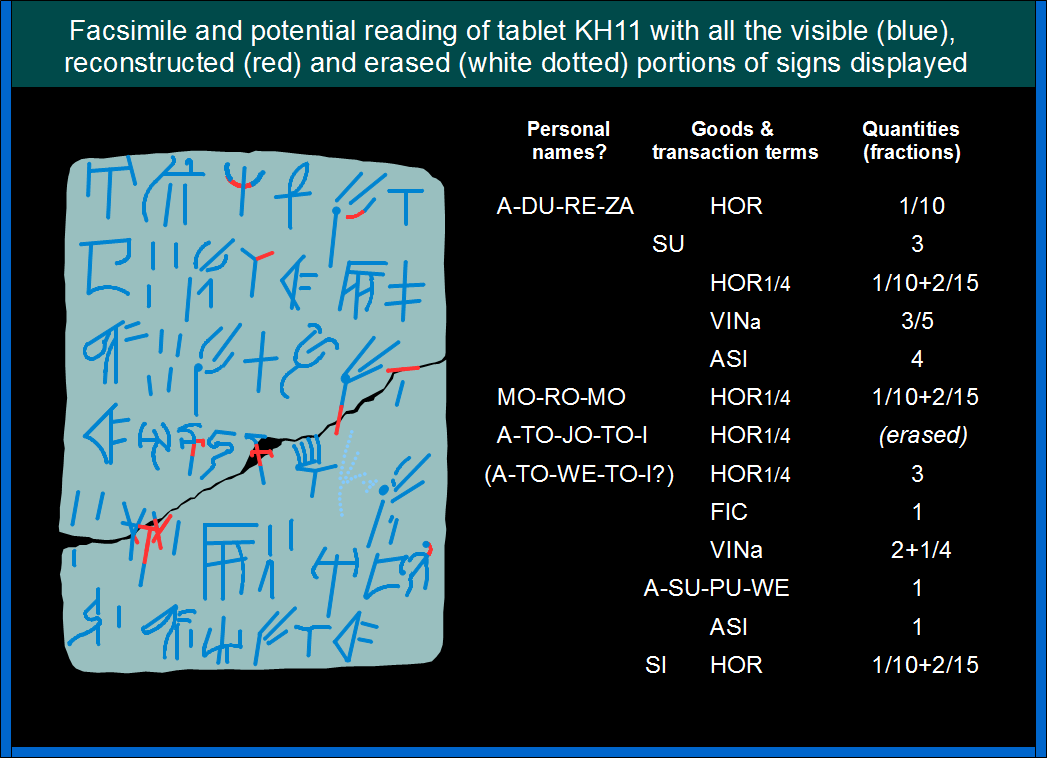
Fortunately, there are some spectacular Linear A documents that help us in our quest more than a thousand other tablets. In this post, I will be focusing upon the clay tablet KH11. Although it may appear as an oddball of a specimen at first, we shall see soon that these features are explainable with the tablet being in some sense "transitional" towards Linear B: both in style and in context!


You can see the facsimile of KH11 and the suggested reading of its entries on figure #1. Note that I have been playing with the values of fractional signs a lot, slightly altering some of the traditionally assigned numbers. Although nothing is set in stone yet, this is something that I plan to make a separate post later on. I will not mention the details here: everything comes at its own time.

The first entry of KH11 starts with the word A-DU-RE-ZA. It has two possible interpretations: first of all, it could be a pair of separate words: A-DU  RE-ZA (transaction term + toponym). But it is more probable that the table refers to persons instead of places (due to the small quantity of goods mentioned). This could also happen if A-DU-RE-ZA (as a single word) was a personal name or title somehow derived from DU-RE-ZA (mentioned on KH20, also recurring on ZA10 and ZA20 in the form DU-RE-ZA-SE), another place-name. On KH11, every donor (person?) delivers an array of different goods, often with small, fractional quantities. The most important of them was marked with the logogram *303. Based on the context of other tablets (e.g. KH6, KH7) and the shape of the sign, it must have been an important foodstuff for humans and animals alike, most likely a type of grain: barley. Two common variants exist in Linear A: the bare *303 sign - that I labelled HOR (Latin hordeum = barley) - and "fractionalized" variants, for example HOR+1/4. The meaning of the latter is unclear, though the GRA sign (grain: likely wheat) also somes with similar fractional ligatures. Another type of goods was labelled with *306. This sign is mostly phonetical in Linear A, with the possible value WO (same as Lin B WO). But on the KH tablets, it also denotes a type of agricultural goods. It comes in integer quantities only, and *306 looks like an animal head, so I assigned it the reading donkey, ASI (Latin asinus = donkey). Other tablets from Khania (e.g KH 6) also list animals with portions of barely - usually, it cannot be decided whether the barely was a low-quality one, used as fodder, or intended for human consumption.

Although the sign Lin A *303 is slightly dissimilar in shape to the Linear B sign denoting barley, it still very closely resembles a purely phonetic sign: Linear B MO. Immediately in the second line of KH11, we also see a series of two *303 signs next to each other. This is almost impossible to explain as pure logograms. Godart & Olivier noted that one of these signs contains a tiny extra stroke, so they designated it as a new sign, *348. Nevertheless, its graphic image does not support the distinction. Also, why would one repeat the same type of goods from one donor three times over? It is way more sensible therefore, to read these *303 signs not as HOR, but with a phonetic value: MO. This yields a new name in the second line: MO-RO-MO (the middle sign should be RO instead of fraction B). This is the first time we see a genuine MO (= Lin B *15) in Linear A.

And the tablet just keeps giving surprises. In the third line, we can read another name, transliterated by J. Younger as A-TO-*349-TO-I.The penultimate sign is damaged, so we cannot meaningfully decide whether it was indeed TO or NA instead. But the one identified as *349 looks fairly similar to the Linear B JO sign: especially with its "wavy" shaft. It is generally dissimilar to anything other in Linear A, except perhaps the very peculiar TO sign on the vessel KN10 (that could also be a JO, by the way). So now we have another name with a lot of 'o' sounds in it, probably A-TO-JO-TO-I. Serious caution is adviced, though, before defining a new sign-class from a single occurrance. The Linear B JO sign is also possible to derive - by simplification - from other signs, most prominently Lin A *310. At the same time, *349 could also be a regular *301 sign, to which the scribe simply forgot to add a vertical stroke. This would support a reading A-TO-WE-TO-I instead (very putatively: *Αρτοϝενθοι from Ancient Greek αρτος, bread - see the discussion later).


The last full word on the tablet is equally interesting: It starts with an A, surely enough. The second sign is a hastely written SU (and probably not TA). The third sign - for some inexplicable reasons - was given a unique identifier (*350) by Godart: I am not sure why, because it looks like a good-enough PU sign for me. The last syllabogram of this word is the well-known *301 - in its "wavy" variant. It does not only look like Linear B WE, but also gives a meaningful reading this way: the word is thus A-SU-PU-WE - known from other Linear A tablets in different forms (A-SU-PU-WA on ARKH2 and A-SI-SU-PO-A on KH9). Judged by the context (no logogram follows it), it is probably a transaction term - I have no better idea.

The conclusion that *301 can in fact be read as WE also receives a nice reinforcement from another source: The inscribed vessel TY Zb4 shows a correcture *306 → *301. Although it was probably incorrect (the form *306-KI-TA or WO-KI-TA is known from other sources), the error was not particularly big if *301 was indeed WE. This also means that we can now finally read the first words of the libation formulae in full. Although A-TA-I-WE-WA-JA or TA-NA-I-WE-U-TI-NU are a bit unexpected due to the high frequency of semivowels, we have no real reason to dismiss this reading. It is also possible that one or more additional consonants were ommitted here. Just remember that clusters like *-rw- also get simplified to *-w- in Linear B (c.f. KO-WO from *korwos = boy). If one observes carefully, the shape of Lin A *301 also shows a clear evolution. The earlier (Middle Minoan) verson is still similar to its Hieroglyphic ancestor (the "adze"-figure), while the Late Minoan versions are gradually becoming more-and-more similar to a "dollar" character. They are also frequently mirrored all the time. Finally, the central shaft is ommitted, and we have the snake-like Linear B *75 = WE sign!


But how can we interpret all these unusual names on KH11? Their most prominent feature - the one that triggered the use of "rare signs" - is the high frequency of 'o' vowels. This is uncommon in Minoan contexts, but it is perfectly what we would expect if their bearers were Mycaenean Greeks. Indeed, this tablet (as all the Khania tablets) comes from the end of the Late Minoan Ib period (approx. 1425 BC). This was a time of great turmoil, war and destruction on Crete: many of the cities were burnt to the ground, never to be re-settled again. And even in those that remained inhabited, the subsequent appearence of Linear B inscriptions (in early Greek) points to a shift of power - to a centralized Mycaenean administration controlled by a Greek-speaking aristocracy. While the destruction on the eastern end of the island was severe at the end of LMIb, the transition was probably less violent in the west (note that Khania as well as other settlements remained inhabited without a major break). And it is perfectly possible that some Greek individuals were already present on the island in the LMI era, well before a major wave of continental Greeks reached and settled on Crete in the LMII period. Linear B itself is more-or-less a straight continuation of the (150 years earlier) late Linear A script, without any major changes to the phonetic values, ortography, or the shapes of the signs. This gives hope that - one nice day - the phonetic values behind even the most mysterious Linear A signs will be deciphered.